The Slow Charge Illusion: Why a Domestic Socket Is a Demanding Route to EV Ownership
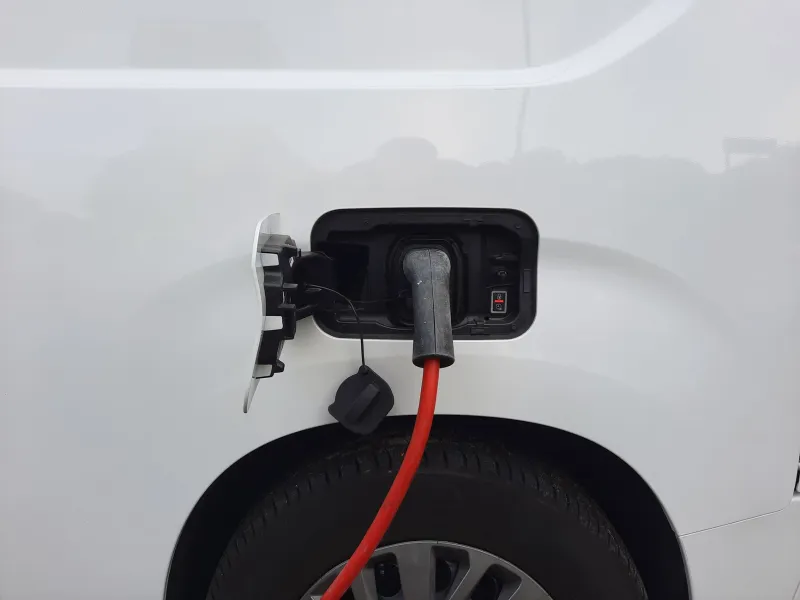
For many UK households, the first electric vehicle arrives with a three-pin charging lead. Often called a granny charger, it promises an overnight top-up from an existing socket, with no wallbox, no trench across the drive and no apparent paperwork. It is an understandable starting point. It is also one of the most misunderstood options in domestic electrical planning.
From a wiring perspective, the apparently gentle route is not automatically the low-stress one. A 13A socket is designed for intermittent domestic loads, not necessarily for many hours of sustained high current. The demand may look modest compared with a 7kW wallbox, but the duration of the load changes the picture. Heat has time to build in plugs, socket contacts, fused spurs and extension leads. Components that perform perfectly well for a kettle or a vacuum cleaner can be asked to do something quite different when a car is connected for six, eight or ten hours at a time.
Why a three-pin socket is not a low-stress option
A portable EV charger may draw around 10A for long periods. That is close enough to the upper end of a typical 13A socket circuit to leave little margin for poor contact resistance, worn accessories or a loosely fitted plug. Ring final circuits are designed with diversity in mind; they are not intended to support every outlet at near-maximum load simultaneously. Add an extension lead, a coiled cable, a socket on a spur, or an older outlet with tired spring contacts, and the risk of local overheating increases.
There is also the question of residual current protection. A dedicated EV chargepoint normally includes 6mA DC leakage detection as part of its protective arrangement, because vehicle charging can introduce DC residual current that affects some types of RCD. A portable charger plugged into a general socket relies on whatever upstream protection exists, which may not have been selected with EV charging in mind. Outdoors, the practical risks multiply: trailing leads across wet paving, cables through windows, mechanical damage and strain at the plug.
None of this means a three-pin charge is automatically unsafe in every circumstances. It does mean it should be treated as an installation question, not a plug-and-play accessory.
What a dedicated wallbox changes
A 7kW wallbox is usually supplied by its own dedicated circuit, typically rated at 32A on a single-phase supply. Cable size is selected for current-carrying capacity, voltage drop, installation method, ambient temperature and grouping with other circuits. The protective device is chosen for the application, often an RCBO or an RCD arrangement incorporating 6mA DC detection, with surge protection considered as part of the wider installation. Earthing arrangement, open PEN fault protection where required, isolation and cable routing all form part of the design.
The dedicated approach also makes control possible. A wallbox can communicate with the vehicle, limit charging current and, where fitted, work with dynamic load management. That matters in homes where the supply head has limited spare capacity.
Load management and the real capacity of the supply
Many UK homes have a single-phase supply with a 60A, 80A or 100A service fuse. The consumer unit may have spare ways, but that does not prove the service head has spare capacity. Electric showers, ovens, immersion heaters, heat pumps and induction hobs all compete for the same supply. A 7kW chargepoint adds a substantial continuous load.
Load management uses a current sensor to monitor the whole installation and reduce charging rate when household demand rises. This can allow a chargepoint to be installed without an immediate supply upgrade in some cases, but it is a design decision rather than a workaround. The installer must assess maximum demand, diversity and the condition of the service equipment. Where the supply is looped to a neighbouring property, or the cut-out is old and showing signs of heat, the distribution network operator may need to be involved before any chargepoint is energised.
DNO notification and the paper trail
Home EV charging is not simply a private upgrade behind the consumer unit. The installer should assess whether the connection requires notification or approval from the distribution network operator. Some installations proceed with a standard notification; others need a limited charger setting, a supply upgrade or other network work. In England and Wales, a new circuit is also notifiable under Part P, and a registered competent electrician can self-certify the work.
Homeowners should expect a certificate, test results and clear documentation. If a quote for a wallbox does not mention supply assessment, protective device selection or DNO notification, it is worth asking why.
Cable routing practicalities
A chargepoint is only as good as the route to it. Longer cable runs increase voltage drop and may require a larger conductor size. Cables passing through thermal insulation need derating. External runs may call for steel wire armoured cable, conduit or another suitable mechanical protection. Trenches, driveways, drainage, listed-building constraints and rented properties all affect the plan.
The position of the chargepoint matters too. Consider cable reach to the vehicle, whether a tethered or untethered unit suits the household, accessibility, weather exposure and future second-vehicle use. A neat installation is usually one that was designed before the first cable was pulled.
Warning signs that the existing supply needs attention
Before adding any EV charging load, an electrician should look beyond the consumer unit. Warning signs include an old service cut-out with a small fuse rating, perished meter tails, a lack of main protective bonding, a looped supply, signs of overheating at the service head, or a TN-C-S earthing arrangement with inadequate bonding to incoming metallic services. A consumer unit with no RCD protection, or one that has been altered by unqualified hands, also warrants a full assessment.
The slow charge illusion is that a three-pin plug feels less demanding because it draws less current. In practice, sustained charging can expose weaknesses that short, intermittent loads never reveal. The sensible route is to have the installation assessed first, then decide whether a dedicated chargepoint, a managed connection or a supply upgrade is the right answer for the property.