The Quiet Risk Behind the Fixing: Reading a Wall Before You Drill

A fixing task is brief: mark a point, choose a bit, drill a hole. The consequence, however, can last far longer than the shelf. In many UK homes, cables are buried directly in plaster or set within partitions, often with little visible evidence of their route. The aim of this guide is not to make every homeowner fearful of a picture hook. It is to encourage a measured sequence before the drill bites, so that a small job does not become an electrical repair.
The fixing is the moment of risk
Drills, screws and nails do not discriminate. A masonry bit can pass through plaster and into a cable with little resistance, and a screw can make contact with a conductor without the user feeling anything at the time. The immediate result may be a tripped protective device, a flash, or nothing at all. The more troubling outcome is a cable that has been damaged but not severed: insulation may be compromised, a conductor may be partly cut, or a fixing may remain in contact with a live part.
Residual current devices and miniature circuit breakers reduce risk, but they do not make drilling into a wall safe. An RCD is intended to reduce the duration of certain earth faults; it is not a substitute for avoiding the cable in the first place. A circuit breaker may not operate for a small leakage current or for a fault that has not yet developed into a short circuit. The practical lesson is simple: protection at the consumer unit is a backstop, not a permission slip.
Safe zones are a map, not a guarantee
BS 7671, the UK wiring regulations, sets out the principle of safe zones. Cables concealed in walls or partitions at a depth of less than 50mm are expected to be routed within defined zones or to have additional protection. These zones generally include the area within 150mm of a ceiling, the area within 150mm of a corner, and the vertical or horizontal band aligned with an accessory such as a socket, switch or consumer unit.
That is useful design guidance, but it is not a live map of every cable in the property. Alterations, extensions and DIY additions may have introduced routes that do not follow the original convention. A cable may run diagonally to a spur, pass through a wall at an unexpected height, or be buried more deeply than expected. Safe zones tell you where cables are most likely to be; they do not tell you where they certainly are.
What a cable detector can and cannot tell you
A cable detector is a useful first-pass tool. Most domestic models sense the electromagnetic field around a live cable, often alongside a stud or metal detection mode. Used carefully, they can highlight an area that deserves investigation. They should not be treated as an oracle.
A detector may fail to register a cable that is dead at the time of testing, one that is enclosed in earthed metal conduit, one that is too deep for the instrument, or one carrying too little current. It may also react to pipes, reinforcement, foil-backed insulation or other metallic features. Some models are more prone to false positives than others, and readings can change with the angle of the device and the surface being scanned.
A negative reading is therefore not proof that the wall is clear. A positive reading is not necessarily proof of a cable. The correct interpretation is more modest: the detector has given you a reason to slow down, scan again from another direction, and consider the evidence before committing to a hole.
Read the wall before the equipment
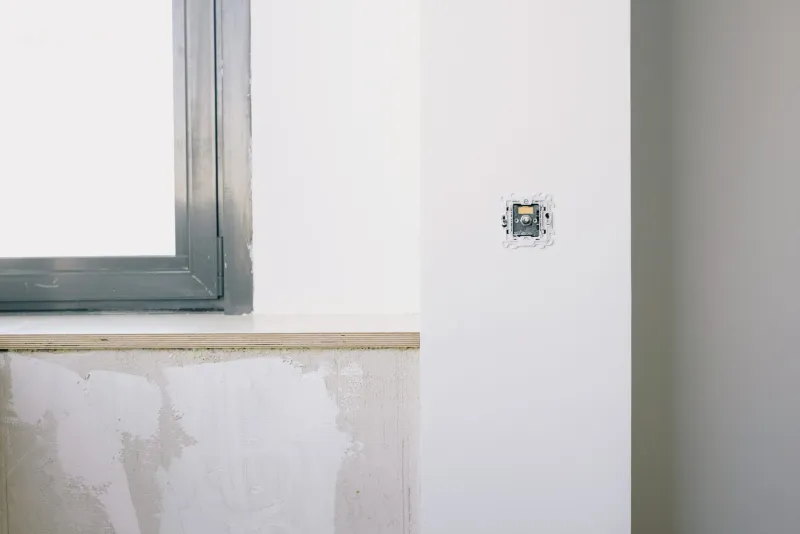
The most reliable clues are often visible before any gadget is switched on. Look at the positions of sockets, switches, spurs and blanking plates. Consider what they supply: outside lighting, a boiler control, an alarm keypad, a kitchen appliance, a shower pump. Cables usually need to reach those accessories by a sensible route, even if the route is not the one you would have chosen.
Check the consumer unit for labels, but treat them as a starting point rather than a guarantee. Labels may be outdated, incomplete or optimistic. Look for signs of previous alteration: recent plaster patches, trunking, capping, conduit, extra back boxes, or a socket in an unusual position. In kitchens, remember that cables often rise vertically from worktop accessories. In bathrooms, the zones around fittings deserve particular caution, and any fixing near a shower or bath should be approached with extra restraint.
If the wall is accessible from the other side, or from a loft or floor void, inspect it. Lifting a floorboard or looking behind a plasterboard partition can reveal more than any handheld detector. This is not always practical, but where it is, it is time well spent.
When the wall is not what it seems
Older properties can be especially deceptive. Lath and plaster, dot-and-dab dry lining, timber stud partitions and solid masonry all behave differently under a drill. Cables may sit within conduit, behind capping, or in a shallow chase that has been skimmed over many times. Foil-backed insulation can confuse detection equipment. Steel conduit can shield a live cable from a basic detector while presenting its own hazards.
A wall may also contain services other than cables: water pipes, gas pipes, drainage, or structural fixings. The presence of one does not rule out the others. In a room that has been refurbished, the wall may be a patchwork of old and new work. The appropriate response is not to assume the worst, but to avoid assuming the best.
A calm sequence before the drill bites
Begin by deciding what the fixing actually needs. A shallow plug and screw for a picture frame is a different proposition from a deep anchor for a wall cabinet. Choose the shortest and least invasive fixing that will do the job. If the fixing can be placed away from accessories and known cable routes, so much the better.
Next, gather evidence. Review the positions of accessories, look for visible routes, and scan the area with a detector in several directions. Mark any readings and compare them with what the wall is telling you. If the reading is inconsistent, move the fixing rather than arguing with the instrument.
Where practical, isolate the relevant circuit before drilling deeply, and prove that the circuit is dead with a suitable tester. A non-contact voltage pen is not a proving instrument. If isolation is not practical for a shallow fixing, keep the drill depth controlled and stop immediately if you meet unexpected resistance, blue or black debris, or any sign of cable sheath.
Use a pilot hole before a full-size bit. Stop if the drill breaks through sooner than expected or if the wall feels hollow in a way that suggests a partition containing services. Never chase a wall deeper than you intended without understanding what lies beneath the plaster.
When to stop and call a qualified electrician
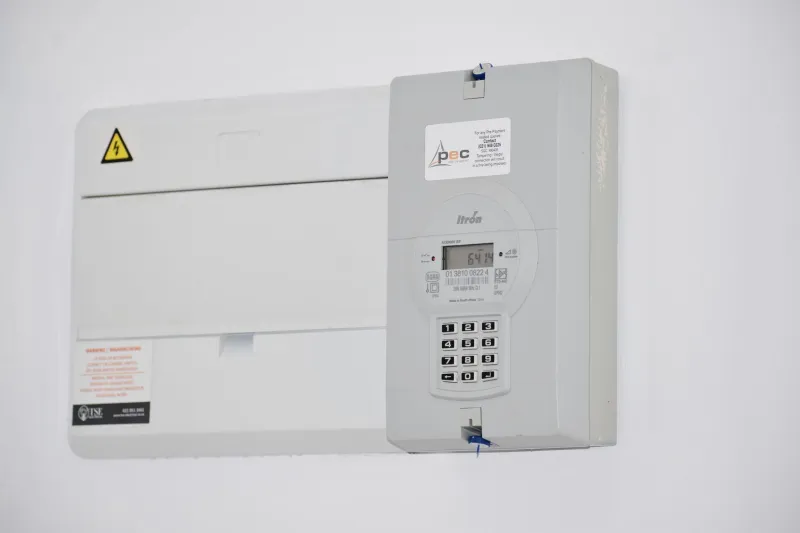
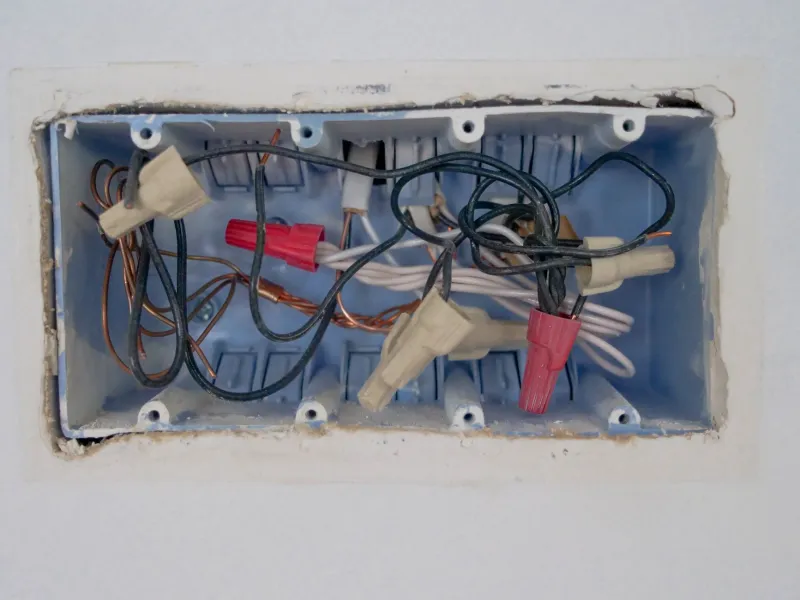
Stop work if a detector gives strong but inconsistent readings, if you find conduit or cable where you did not expect it, or if the property has old wiring with limited evidence of recent inspection. Stop if the fixing is close to the consumer unit, meter tails or service head, or if the job requires a chase deeper than the safe zone guidance allows. Stop immediately if a drill strikes something, a protective device operates, or you notice a burning smell, scorch mark or exposed conductor.
Do not plaster over a damaged cable and hope. Isolate the circuit if it is safe to do so and seek qualified advice. A damaged cable may continue to function for a time, which is precisely what makes it dangerous.
The few minutes spent reading a wall are rarely wasted. A detector is a helpful assistant, not a replacement for an understanding of the installation. The safest approach is neither blind confidence nor excessive fear, but evidence, restraint and a willingness to stop when the wall is hiding more than plasterboard.