Powering the Garden Room: A Practical Safety Framework for Outbuildings
Photo: don cload , CC BY-SA 2.0, via Wikimedia Commons
Why garden-room power is different
A garden room is no longer just a summerhouse with a light and a kettle. For many UK homeowners it is a daily office, a studio, a workshop or a guest space. That change in use brings a change in electrical demand, and it exposes the difference between an indoor circuit and one that has to survive weather, distance and garden activity.
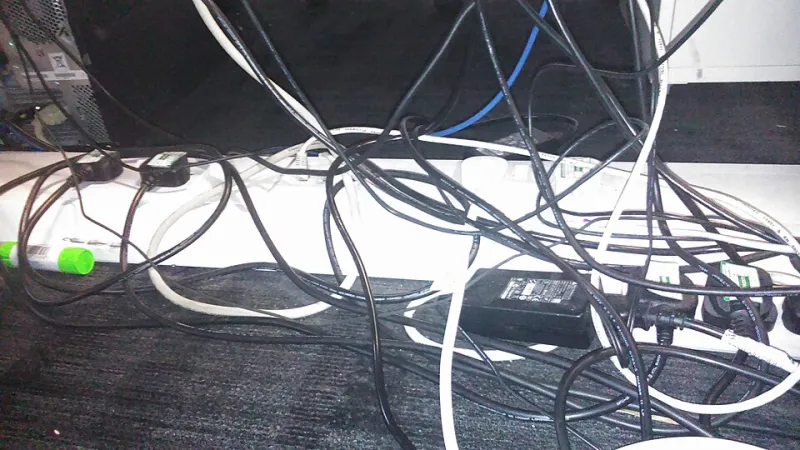
The most common mistake is to treat the outbuilding as an extension of the house's ordinary socket circuit. A trailing lead across a patio is not a supply. It is a temporary measure with a permanent risk. A proper garden-room supply should be designed, installed and tested as its own installation, with protection suited to the environment.
Start with the load, not the socket
Before choosing an outdoor socket or a cable, list what will actually run in the building. A laptop and a lamp are modest. A 2 kW heater, a kettle, a monitor and a printer are a different proposition. If the garden room may later gain an air-conditioning unit, a small kitchenette or a hot tub, say so at the planning stage rather than discovering the limit afterwards.
The electrician will calculate the load and check the capacity of the existing supply. The question is not simply whether there is a spare way in the consumer unit. It is whether the earthing arrangement, the main protective devices and the distribution board can accommodate the new demand without compromising the rest of the house.
Outdoor sockets: IP ratings and sensible positioning
Outdoor socket outlets should be chosen for the environment, not simply mounted in a convenient spot. An appropriate IP rating, such as IP65 for many outdoor enclosures, gives protection against dust and water jets, but the enclosure is only part of the story. The socket should be positioned so that water cannot collect around it, and it should not face upwards or sit where a hose, drain or gutter will discharge onto it.
Cables should enter enclosures properly, with glands and seals that maintain the rating. A socket protected by a flap is not weatherproof if the cable entry is left open. Trailing leads should be avoided outdoors; where a lead is unavoidable, it should be suitable for outdoor use, kept off standing water and not run through a doorway where it can be pinched.
Armoured cable and the route
Steel wire armoured cable is widely used for outbuildings because it provides mechanical protection. It is not a universal solution, and it is not a substitute for calculation. The cable size depends on the load, the length of the run, the installation method and the permitted voltage drop. A long run to the end of a garden can require a larger conductor than a short one, even for the same appliance load.
The route matters as much as the cable. It should be agreed before digging begins, with attention to drainage, tree roots, future landscaping and any other buried services. A qualified electrician will specify the installation method and the protection required. Ordinary indoor flex buried in soil or clipped loosely to a fence is not an acceptable garden supply.
RCD protection and isolation
Socket outlets outdoors require appropriate additional protection, and in practice that usually means 30 mA RCD protection. The device may be at the origin of the supply, in a local enclosure or as part of a dedicated outbuilding consumer unit, but it must be selected and installed correctly. A label identifying the protected circuits is helpful, and the test button should be operated regularly as part of the homeowner's routine.
Isolation is the other essential. The garden room should have a clear means of switching off its supply for maintenance or in an emergency. That may be a local isolator or a switch-fuse arrangement, depending on the design. It should be accessible, labelled and not hidden behind stored furniture.
Earthing and bonding questions
The earthing arrangement for an outbuilding is not a detail to leave to chance. Depending on the supply type and the distance from the house, the electrician may need to consider whether the earth is exported, whether a separate earth electrode is appropriate, and whether any metallic services in the building require bonding. These are technical decisions, and they should be recorded as part of the installation design.
Questions to ask before work begins
- Has the total load been calculated, including likely future use?
- Has the capacity of the existing consumer unit and supply been checked?
- What cable type and size will be used, and why?
- How will the cable be routed and protected?
- What RCD protection will be provided, and where?
- Will there be a local isolator in the garden room?
- How will the earthing arrangement be handled?
- Is the work notifiable under Part P in England or Wales?
- What test certificates will be provided on completion?
The safe bottom line
A garden room deserves a supply that is planned like any other permanent installation. That means calculating the load, choosing the right cable and protection, providing isolation and testing the result. It is a modest amount of design work compared with the inconvenience of a tripping supply, a damaged cable or a socket that was never suitable for the British weather.