What Older UK Homes Hide Behind the Skirting: A Room-by-Room Electrical Check
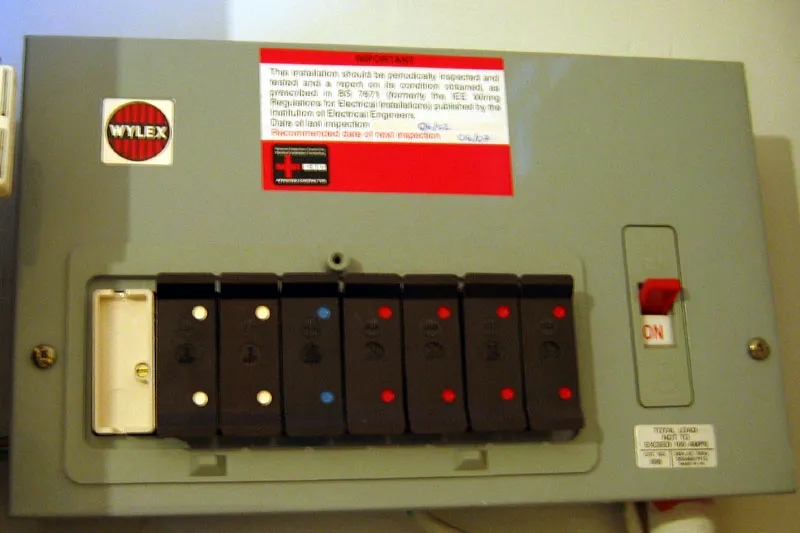
Photo: The original uploader was Secretlondon at English Wikipedia., CC BY-SA 3.0, via Wikimedia Commons
Age is a clue, not a verdict
A great many UK homes still in daily use were wired to standards that nobody would specify today. Cables sheathed in vulcanised rubber, lighting circuits run without a circuit protective conductor, and fuse boards with a wooden back and a row of rewirable carriers are all still out there, quietly doing their job behind plaster and under floorboards. The important point for homeowners is this: the calendar is a poor diagnostic tool. A 1950s installation that has been periodically inspected and sensibly maintained may be in better order than a 1990s one that has been extended by successive rounds of DIY. What follows is intended as a structured visual audit, not a substitute for an Electrical Installation Condition Report carried out by a competent person.
Begin at the consumer unit
Before touring the rooms, find the origin of the installation. Older properties frequently present one of three arrangements: a modern consumer unit with miniature circuit breakers and residual current devices, a mid-century board with rewirable fuse carriers, or, in some cases, two boards side by side following a partial upgrade.
Points worth noting:
- Fuse carriers that take fuse wire, particularly where the wire gauge looks inconsistent from one carrier to the next.
- A main switch that isolates only the line conductor rather than both line and neutral.
- No residual current device protection on socket circuits, lighting circuits or the circuits serving an outside location.
- Enclosures with a wooden backing, asbestos-containing flash guards, or obvious scorching and heat discolouration around the carrier positions.
- Labels that are missing, illegible, or plainly inaccurate, which usually indicates unrecorded alteration.
A consumer unit of this sort is not automatically dangerous, but it does represent a lower level of protection than a modern board with individual RCBOs. Where a rewirable board remains in service with no RCD coverage, a planned upgrade is generally the most straightforward route to meaningful improvement.
Hallway and understairs
These are the places where alterations accumulate. Look at the meter position and any associated tails, seals and isolators, and check whether cables are mechanically protected where they emerge from the floor. Under the stairs, note any exposed cable runs that have been clipped badly, taped, or left resting against pipework. Rubber-insulated cable that has been bent sharply will often show a crazed, crumbling surface at the bend, and that is a genuine indicator that the insulation has perished.
Kitchen
The kitchen concentrates more load into a smaller space than any other room, and older wiring was not designed for it. A circuit installed decades ago for a single socket may now feed a dishwasher, a washing machine, a kettle and an air fryer through a chain of adaptors.
Check for:
- Socket outlets that feel warm to the touch, or show brown discolouration around the pin apertures.
- Round-pin sockets still in service, which should be treated as a sign that the circuit has not been reviewed in a very long time.
- Fused connection units serving appliances, and whether the fuse rating matches the appliance.
- Cabling run behind units or under worktops that has been damaged by screws or abrasion.
Bathroom
Bathrooms sit in a zone where the regulations are strictest, and older properties often fall short. Look for supplementary bonding conductors that have been disconnected during a bathroom refit, and for shaver sockets or bathroom lights with no protective earthing. A metal light fitting on a lighting circuit with no circuit protective conductor is a combination that should be inspected without delay, particularly where the fitting is within reach of the bath or shower.
Living rooms and bedrooms
This is where trailing leads and extension arrangements tend to live. Cast an eye over the sockets themselves: cracked plates, single insulated flexes disappearing under carpets, and plugs with the wrong fuse fitted are all common. If the property still has two-core flex feeding pendant lights from a ceiling rose, that is not unusual for its era, but it does mean metal light fittings and switches need careful thought.
Loft, garage, shed and garden
These areas are forgotten, and that is precisely why faults persist there. In the loft, look for cables buried under insulation, junction boxes left open, and rodent damage. In a detached garage or garden shed, a supply taken from the house on a circuit with no RCD protection, or an outdoor socket with a broken flap, deserves professional attention.
When to act, and when to observe
Arrange an inspection promptly if you notice any of the following: a persistent burning smell with no obvious source, scorch marks at an accessory, buzzing from a board or fitting, a circuit that trips repeatedly, sockets or switches that are warm in normal use, or exposed single-insulated conductors. There is a strong case for an Electrical Installation Condition Report every ten years, or on moving into a property, and the current edition of BS 7671 is the reference point against which the installation should be judged.
By contrast, discovering that the wiring is old, or that the board uses rewirable fuses, is not in itself an emergency. It is information. It tells you to budget for a consumer unit upgrade in the near future, to have the earthing and bonding verified, and to keep an eye on the installation rather than ignore it.
A sensible sequence
In practical terms, the sequence for most older homes is straightforward: a condition report to establish the facts, a prioritised schedule of remedials, and then informed decisions about larger work such as a board replacement or a partial rewire. Where a consumer unit upgrade is recommended, it should be matched to the actual loads in the property rather than treated as a like-for-like swap.
If you are uncertain about anything you have seen during your own walk-round, Jaydee Electrical can carry out a professional assessment and explain the findings in plain terms, so that the next step you take is an informed one.